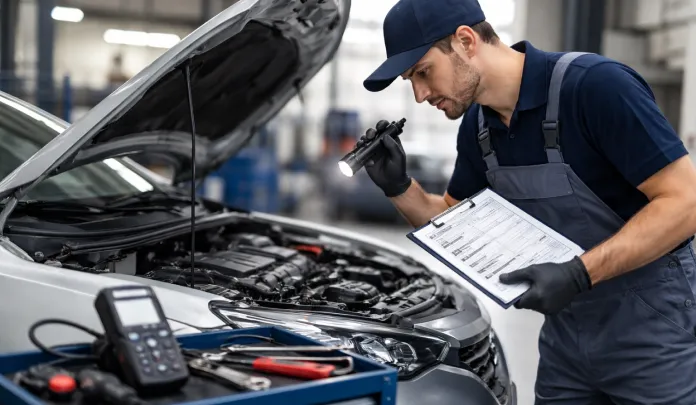
You’re standing in a dusty lot in Ras Al Khor. The car looks mint. The interior smells like expensive leather and success. But then, the Dubai car inspection report comes back.
There’s a “minor oil leak” and a “repaired chassis.” One sounds like a messy driveway; the other sounds like a skeleton that’s been snapped and glued back together.
Which one do you run away from?
The short answer: The repaired chassis is the nuclear option. While an oil leak can be a headache, a compromised frame is a permanent scar on the car’s safety, value, and soul.
Table of Contents
| No | Section Name |
|---|---|
| 1 | Why a Repaired Chassis Is the Ultimate Red Flag |
| 2 | Is a Minor Oil Leak Actually a Big Deal? |
| 3 | The Verdict on Dubai Car Inspection |
| 4 | FAQ |
Why a Repaired Chassis Is the Ultimate Red Flag
In the world of a Dubai car inspection, the chassis is the foundation. If it has been straightened, welded, or “stitched,” the car is technically a “salvage rebuild,” even if the seller claims it was just a “minor bumper scuff.”
Safety Is Non-Negotiable
Modern cars have crumble zones designed to absorb impact once. If a chassis has been repaired, those zones are weakened. In a second accident, the metal won’t behave the same way. It might fold like a soda can instead of protecting you.
The "Ghost" Alignment Issues
A repaired frame is rarely 100% straight. You’ll notice the car pulling to one side, or worse, eating through tires every 5,000 kilometers. No amount of laser alignment can fix a crooked bone.
Resale Value Suicide
Try selling a car with a “chassis repair” note on the technical report in the UAE. You’ll be lucky to get 50% of the market value. Banks often refuse to finance these cars, and insurance companies might only offer third-party coverage if they cover it at all.
Is a Minor Oil Leak Actually a Big Deal?
Don’t get me wrong; oil leaks aren’t “good.” But in the context of a Dubai car inspection, they are often a negotiation tool rather than a reason to cancel the deal.
The "Heat" Factor
Dubai’s 50°C summers are brutal on rubber seals and gaskets. It is common to see a valve cover leak on a five-year-old Audi or a rear main seal weep on a Mercedes. These are maintenance items, not structural failures.
Repairable vs. Terminal
Most leaks are fixed by replacing a gasket. Sure, some like a rear main seal require dropping the transmission and might cost a few thousand Dirhams, but once it’s fixed, the car is “whole” again. A chassis is never truly “fixed.”
The Verdict on Dubai Car Inspection
Sellers in the UAE are masters of the “cheap polish.” They use heavy-duty steam cleaners to hide oil leaks and thick undercoating to mask chassis welds.
This is why a basic RTA pass isn’t enough. The RTA checks if the car is safe now; they don’t necessarily tell you if the car was a total loss in the US and “reconstructed” in a back-alley workshop in Sharjah.
If your Dubai car inspection reveals a repaired chassis, walk away. There are thousands of cars in this city. Don’t buy the one that’s been through a blender.
If it’s just a leak? Use the repair estimate to knock AED 3,000 off the asking price and get it fixed at a specialist.
FAQ
Yes, and that’s the scary part. If the repair is "neat" or the damage is behind the main pillars, it might pass the basic safety check. But just because it’s "legal" to drive doesn't mean it’s safe or worth your money.
Check where it’s coming from. A valve cover leak is a minor fix. A head gasket leak or a cracked engine block? That’s when you hand the keys back and leave.
Not always. If the previous owner fixed it "under the table" at a private garage without an insurance claim, the history report will look clean. Only a physical inspection with a paint depth gauge and a pro eye will catch it.
Only if you plan on driving it into the ground and never selling it. But even then, you’re gambling with your safety. We wouldn’t recommend it to our friends, so we won't recommend it to you.